Brother Lawrence, who visited campus on Monday to talk about Facebook, sent me this message.
Subject: When the Ex Blogs, the Dirtiest Laundry Is Aired - New York Times
"Thought you might want to share this with your class. You can tell them I sent it to you on facebook!"
It gives another example of the Dark Side of the Net... the opportunity to share EVERYTHING you want with hundreds of thousands of people... It is another example that makes me wonder what is happening to our notions of "public" and "private." Post comments here and we can talk more in class.
Friday, April 18, 2008

100+ Virtual Worlds!!
One of the eLearning mailing lists I subscribe to is George Sieman's eLearning News and Resources (ENR) (subscribe bere). This week's posting focuses on "Visualization, Journalism, Virtual Worlds, and Video." The segment on Virtual Worlds is reporting from an April 3-4 Conference in New York City which includes over 100 links for current and underdevelopment virtual world sites. The majority target teens and younger users. A quick glance of the list indicates that a large number of the sites are commercially oriented or sponsored (i.e. Disney's Bunnytown and BarbieGirls). NASA's underdevelopment Education World is one of the few exceptions.
As we are exploring "Online Religion," that is religious and spiritual expressions that exist only online, it is important to critique the context within which they operate and how they are influenced by their virtual neighbors. I'd be curiouys to hear what impact you think such circumstances create?
As we are exploring "Online Religion," that is religious and spiritual expressions that exist only online, it is important to critique the context within which they operate and how they are influenced by their virtual neighbors. I'd be curiouys to hear what impact you think such circumstances create?
Wednesday, April 16, 2008
Last Class
As a way to bring closure to the class, please create a post that
1) identifies any key insights or new learnings you have gleaned from this class and
2) describes how you will integrate what you have seen and/or heard into your praxis (theology and practice).
1) identifies any key insights or new learnings you have gleaned from this class and
2) describes how you will integrate what you have seen and/or heard into your praxis (theology and practice).
Monday, March 31, 2008
Religion Online
During tonight's class, Daniella and Elizabeth led us through some of the layers of Roman Catholic and Episcopal websites. I will post their presentations in our Blackboard site under Course Documents for your review. I will also open a few threads for continued conversation. Some of the elements that you may want to consider that I wrote on the board include:
Daniella's five-point lens from Our Hearts are Burning Within Us
* Community
* Prayer
* Education
* Relationship
* Active Service
Elizabeth's lens drawn from Massimo Introvigne's article, A Symbolic Universe: Information Terrorism and New Religions in Cyberspace, in which he combines Jordan’s definitions of virtual space with Gackenbach’s psychological categorization of the Internet:
* individual, social and imaginary
* intrapersonal, interpersonal and transpersonal
Other elements to consider for intent and impact include:
WHY? (purpose for going online)
- information sharing
- gateway (to church)
- conversation starter/venting location
- "evangelization" and/or outreach
- prayer/worship
status - "official" vs "unofficial"
priority - funding, staffing, time
authority
creation - volunteer vs professional
maintaining - updating
languages - across whole site or in part
denominational and faith-group differences (Sacrament/sacrament, etc)
I'm sure you have others to add as well. Please do so on Blackboard.
Daniella's five-point lens from Our Hearts are Burning Within Us
* Community
* Prayer
* Education
* Relationship
* Active Service
Elizabeth's lens drawn from Massimo Introvigne's article, A Symbolic Universe: Information Terrorism and New Religions in Cyberspace, in which he combines Jordan’s definitions of virtual space with Gackenbach’s psychological categorization of the Internet:
* individual, social and imaginary
* intrapersonal, interpersonal and transpersonal
Other elements to consider for intent and impact include:
WHY? (purpose for going online)
- information sharing
- gateway (to church)
- conversation starter/venting location
- "evangelization" and/or outreach
- prayer/worship
status - "official" vs "unofficial"
priority - funding, staffing, time
authority
creation - volunteer vs professional
maintaining - updating
languages - across whole site or in part
denominational and faith-group differences (Sacrament/sacrament, etc)
I'm sure you have others to add as well. Please do so on Blackboard.
Thursday, March 20, 2008
Twitter?? Faculty "invasion"? What do you think is appropriate?
The following is an article from The Chronicle of Higher Education online newsletter:
More on Academic Twittering: Breaking Down the Classroom Walls
We've had plenty of interest in our coverage of Twitter (and other micro-blogging services) at colleges, and so it's worth noting that David Parry, who has been a leading experimenter in this area, posted a useful follow-up post yesterday on the AcademHack blog.
Mr. Parry, an assistant professor of Emerging Media and Communications at the University of Texas at Dallas, expands on his philosophy for using Twitter, and offers some fresh pointers to others who have experimented with the service. For instance, he expands on a point he made during our recent Webcam interview, describing what he means by using Twitter to break down the classroom walls: "Students attend college where their identity as a student is just part of what they do and who they are. Many of them have jobs, commute to school, etc., and thus the social aspect of the campus life has changed," he writes.
"If this is the case then these 'new' ways of socializing such as Facebook and MySpace are where students are forming their learning communities, ones which do not entirely, perhaps only minimally, overlap with their classroom experience. Thus to extend the walls of the classroom, make education relevant to all aspects of students lives rather than just what they do four-five hours a day we need to think of ways to extend the ways we form and foster learning communities."
Yet many readers gave mixed reaction to Mr. Parry's basic argument in our most recent Wired Campus post on the topic. "My experience with using Twitter and anything similar — blogs, Facebook, etc. — for academic purposes is that students just think it is weird, creepy, and geeky in the negative sense," one reader said. "And they think that it’s inappropriate for me to be invading “their” space. Within two days of telling my students that I had a Facebook page, I was blocked from all of them." Thanks to everyone who wrote in -- and keep us posted on your own experience with micro-blogging. --Jeffrey R. Young
More on Academic Twittering: Breaking Down the Classroom Walls
We've had plenty of interest in our coverage of Twitter (and other micro-blogging services) at colleges, and so it's worth noting that David Parry, who has been a leading experimenter in this area, posted a useful follow-up post yesterday on the AcademHack blog.
Mr. Parry, an assistant professor of Emerging Media and Communications at the University of Texas at Dallas, expands on his philosophy for using Twitter, and offers some fresh pointers to others who have experimented with the service. For instance, he expands on a point he made during our recent Webcam interview, describing what he means by using Twitter to break down the classroom walls: "Students attend college where their identity as a student is just part of what they do and who they are. Many of them have jobs, commute to school, etc., and thus the social aspect of the campus life has changed," he writes.
"If this is the case then these 'new' ways of socializing such as Facebook and MySpace are where students are forming their learning communities, ones which do not entirely, perhaps only minimally, overlap with their classroom experience. Thus to extend the walls of the classroom, make education relevant to all aspects of students lives rather than just what they do four-five hours a day we need to think of ways to extend the ways we form and foster learning communities."
Yet many readers gave mixed reaction to Mr. Parry's basic argument in our most recent Wired Campus post on the topic. "My experience with using Twitter and anything similar — blogs, Facebook, etc. — for academic purposes is that students just think it is weird, creepy, and geeky in the negative sense," one reader said. "And they think that it’s inappropriate for me to be invading “their” space. Within two days of telling my students that I had a Facebook page, I was blocked from all of them." Thanks to everyone who wrote in -- and keep us posted on your own experience with micro-blogging. --Jeffrey R. Young
Wednesday, March 19, 2008
Online Learning Resources
Lisa asked a pertinent question about where to go to learn about educational technology resources and how to network with people doing this type of work. I've listed a few on the nav bar to the right. Unfortunately, I have not found appropriate church related associations. Feel free to send me links/names you know so we can build a useful list. Thanks. :)
Monday, March 17, 2008
Reminder for tonight's class on Online Learning in Theological Education
(Originally emailed on February 21)
When I created the syllabus, I inadvertently put the wrong URL for the Boston College C21 Online website. The correct URL is http://www.bc.edu/c21online. To prepare for the March 17 class, please go to this site and 1) watch the "demo course," 2) explore the mini-course list, and 3) explore "course info."
Also, to give an overview of the move to theological education at a distance,the syllabus lists some required readings from the Association of Theologicical Schools: Association of Theological Schools, Theological Education, Vol 41, No 1, 2007, (SEE http://www.ats.edu/projects/TE41-1Articles.asp) especially:
* Theological Reflection, Theology and Technology: When Baby Boomer Theologians Teach Generations X & Y by Edward Foley;
* Implications of a Digital Age for Theological Education by William J. Hook;
* Not Just One More Good Idea: A Reflection on the Integration of Digital Technology in Theological Education by Jan Viktora and
* A New Tool or a New Way of Doing Theological Education? by Steve Delamarter
There are also recommended readings:
* Association of Theological Schools, Theological Education, Vol 36, No 1, 1999 and Vol 42, No 2, 2007
* Mary Hess, Engaging Technology in Theological Education, Rowman & Littlefield, 2005.
Please read as much as you can. Remember, posts are due as usual by Sat noon (your reflections on your blog) and Sun evening (your comments to your peers).
When I created the syllabus, I inadvertently put the wrong URL for the Boston College C21 Online website. The correct URL is http://www.bc.edu/c21online. To prepare for the March 17 class, please go to this site and 1) watch the "demo course," 2) explore the mini-course list, and 3) explore "course info."
Also, to give an overview of the move to theological education at a distance,the syllabus lists some required readings from the Association of Theologicical Schools: Association of Theological Schools, Theological Education, Vol 41, No 1, 2007, (SEE http://www.ats.edu/projects/TE41-1Articles.asp) especially:
* Theological Reflection, Theology and Technology: When Baby Boomer Theologians Teach Generations X & Y by Edward Foley;
* Implications of a Digital Age for Theological Education by William J. Hook;
* Not Just One More Good Idea: A Reflection on the Integration of Digital Technology in Theological Education by Jan Viktora and
* A New Tool or a New Way of Doing Theological Education? by Steve Delamarter
There are also recommended readings:
* Association of Theological Schools, Theological Education, Vol 36, No 1, 1999 and Vol 42, No 2, 2007
* Mary Hess, Engaging Technology in Theological Education, Rowman & Littlefield, 2005.
Please read as much as you can. Remember, posts are due as usual by Sat noon (your reflections on your blog) and Sun evening (your comments to your peers).
Sunday, March 9, 2008
ReThinking Academic Technology Leadership in an Era of Change
Aura Fluet, the EDS Reference Librarian, shared a good article with me yesterday. Its a little more technically oriented but it offers another perspective on our upcoming conversation. Educause is one of the primary associations and publications for people interested in educational technology issues. See the article here. Food for thought.
Thursday, March 6, 2008
Food For Thought from Media Ecology....
Weighing InWeb 2.0, Secondary Orality, and the Gutenberg Parenthesis
3/5/2008
By Trent Batson
In the large picture of human history, the brief few centuries when print reigned unchallenged as the most revered form of knowledge will be seen as a mere parenthesis. Before Gutenberg, knowledge was formed orally and, now, in this post-Gutenberg era, knowledge is formed -- increasingly -- through "secondary orality" on the Internet (Walter J. Ong, Orality and Literacy: The Technologizing of the Word. New Accents. Ed. Terence Hawkes. (New York: Methuen, 1988).).
The sequence is: orality --> literacy --> secondary orality as the primary locus of knowledge authority over the last 500-plus years. Over the thousands of years of human history, those 500 years are a parenthesis.
"Gutenberg Parenthesis" is a term Tom Pettitt, Associate Professor of English at the University of Southern Denmark, used at an MIT conference on Folk Cultures and Digital Cultures. ("Before the Gutenberg Parenthesis: Elizabethan-American Compatibilties" Tom Pettitt
http://web.mit.edu/comm-forum/mit5/papers/pettitt_plenary_gutenberg.pdf )
What did writers do before the "Parenthesis"? "Sampling & remixing; borrowing & reshaping; appropriating & recontextualizing," in the words of the call for papers for the conference. This is "the way that some university students now think they should write academic essays," Pettitt says. He says this process, in folklore, is called "quilting." But on campuses, educators call it "plagiarism" unless it is properly cited and does not constitute the majority of the text.
Before Gutenberg, humanity mostly shared knowledge through the spoken word, what is called "orality" -- as opposed to "literacy." During the Gutenberg period, just ending, humanity valued printed works as the foundation of knowledge, and tended to believe knowledge is "owned" by an individual. After this "Gutenberg Parenthesis," humanity is beginning to understand once again, with the Internet, that knowledge is communal. The "Parenthesis" was the anomaly, not the Internet. We are not losing knowledge and learning values, we are reclaiming knowledge and learning values.
Web 2.0 can be defined in a number of ways, technically, by uses, by generational shifts, etc., but underlying all of the definitions is the cultural and historical fact that we are now in a period of "secondary orality" (Walter Ong, Orality and Literacy) that brings us back to the norms and processes of communications that humans have always sustained. Print artifacts, though they continue to hold enormous value, will continue to do so, and are not going away, can no longer be seen as the ultimate or even primary way that our world culture expresses received knowledge.
When we talked of "the late age of print" in the 1980s, such talk quickly came to be seen as delusional: Instead of print going away, we were swamped in new computer-generated print material. Only now with Web 2.0 do we get a concrete demonstration of the social structuring of knowledge and the multiple threads that directly or indirectly lead to any single expression of synthesis of those threads.
-------------------------------------------
Trent Batson, Ph.D., is a researcher, author, and speaker, specializing in ePortfolio research and development. He is also editor of Campus Technology's Web 2.0 e-newsletter. http://www.trentbatson.com.
Cite this Site
Trent Batson, "Web 2.0, Secondary Orality, and the Gutenberg Parenthesis," Campus Technology, 3/5/2008, http://www.campustechnology.com/article.aspx?aid=59351
3/5/2008
By Trent Batson
In the large picture of human history, the brief few centuries when print reigned unchallenged as the most revered form of knowledge will be seen as a mere parenthesis. Before Gutenberg, knowledge was formed orally and, now, in this post-Gutenberg era, knowledge is formed -- increasingly -- through "secondary orality" on the Internet (Walter J. Ong, Orality and Literacy: The Technologizing of the Word. New Accents. Ed. Terence Hawkes. (New York: Methuen, 1988).).
The sequence is: orality --> literacy --> secondary orality as the primary locus of knowledge authority over the last 500-plus years. Over the thousands of years of human history, those 500 years are a parenthesis.
"Gutenberg Parenthesis" is a term Tom Pettitt, Associate Professor of English at the University of Southern Denmark, used at an MIT conference on Folk Cultures and Digital Cultures. ("Before the Gutenberg Parenthesis: Elizabethan-American Compatibilties" Tom Pettitt
http://web.mit.edu/comm-forum/mit5/papers/pettitt_plenary_gutenberg.pdf )
What did writers do before the "Parenthesis"? "Sampling & remixing; borrowing & reshaping; appropriating & recontextualizing," in the words of the call for papers for the conference. This is "the way that some university students now think they should write academic essays," Pettitt says. He says this process, in folklore, is called "quilting." But on campuses, educators call it "plagiarism" unless it is properly cited and does not constitute the majority of the text.
Before Gutenberg, humanity mostly shared knowledge through the spoken word, what is called "orality" -- as opposed to "literacy." During the Gutenberg period, just ending, humanity valued printed works as the foundation of knowledge, and tended to believe knowledge is "owned" by an individual. After this "Gutenberg Parenthesis," humanity is beginning to understand once again, with the Internet, that knowledge is communal. The "Parenthesis" was the anomaly, not the Internet. We are not losing knowledge and learning values, we are reclaiming knowledge and learning values.
Web 2.0 can be defined in a number of ways, technically, by uses, by generational shifts, etc., but underlying all of the definitions is the cultural and historical fact that we are now in a period of "secondary orality" (Walter Ong, Orality and Literacy) that brings us back to the norms and processes of communications that humans have always sustained. Print artifacts, though they continue to hold enormous value, will continue to do so, and are not going away, can no longer be seen as the ultimate or even primary way that our world culture expresses received knowledge.
When we talked of "the late age of print" in the 1980s, such talk quickly came to be seen as delusional: Instead of print going away, we were swamped in new computer-generated print material. Only now with Web 2.0 do we get a concrete demonstration of the social structuring of knowledge and the multiple threads that directly or indirectly lead to any single expression of synthesis of those threads.
-------------------------------------------
Trent Batson, Ph.D., is a researcher, author, and speaker, specializing in ePortfolio research and development. He is also editor of Campus Technology's Web 2.0 e-newsletter. http://www.trentbatson.com.
Cite this Site
Trent Batson, "Web 2.0, Secondary Orality, and the Gutenberg Parenthesis," Campus Technology, 3/5/2008, http://www.campustechnology.com/article.aspx?aid=59351
Saturday, March 1, 2008
Digital Worship: Blessing or Curse
This week's class uses Len Wilson and Jason Moore's book, Digital Storytellers, to consider the opportunities and limitations of including digital media in worship.  Based on the postings from class members websites (see class members postings using links on the right), there will be a lively conversation when we gather face-to-face.
The range of responses can be examined in light of individual and communal assumptions about worship and liturgy. Consider your own assumptions along with what can be extrapolated as those of Wilson and Moore.
How would these assumptions change depending on denomination or faith expression? For example,the American Theological Library Association (ATLA) conducted a Worship Video Project in which Bowld Music Library digitized five Baptist churches in the Dallas/Fort Worth area, Check out some of the recordings. In particular, listen to Dr. Brett Younger's response to the qustion: what would you say is the philosophy or worship at Broadway Baptist Church in Fort Worth Texas? What are the purposes and goals? How does that compare with Next Level Church's video showing What to Expect in worship?
Mary suggested an article from Alban to continue the conversation:
Well-Tempered Worship by Robert Glick. It suggests that "some of the major elements of a well-tempered worship service
* honors Word and Sacrament equally,
* values symbolism,
* values the spoken word,
* welcomes and nurtures the arts,
* honors diversity,
* encourages various forms of prayer,
* remembers the children."
How does this resonate with your beliefs? Are they appropriate criteria for evaluating the use of digital media in worship and liturgy?
What would you add or subtract?
 Based on the postings from class members websites (see class members postings using links on the right), there will be a lively conversation when we gather face-to-face.
 The range of responses can be examined in light of individual and communal assumptions about worship and liturgy. Consider your own assumptions along with what can be extrapolated as those of Wilson and Moore.
How would these assumptions change depending on denomination or faith expression? For example,the American Theological Library Association (ATLA) conducted a Worship Video Project in which Bowld Music Library digitized five Baptist churches in the Dallas/Fort Worth area, Check out some of the recordings. In particular, listen to Dr. Brett Younger's response to the qustion: what would you say is the philosophy or worship at Broadway Baptist Church in Fort Worth Texas? What are the purposes and goals? How does that compare with Next Level Church's video showing What to Expect in worship?
Mary suggested an article from Alban to continue the conversation:
Well-Tempered Worship by Robert Glick. It suggests that "some of the major elements of a well-tempered worship service

* honors Word and Sacrament equally,
* values symbolism,
* values the spoken word,
* welcomes and nurtures the arts,
* honors diversity,
* encourages various forms of prayer,
* remembers the children."
How does this resonate with your beliefs? Are they appropriate criteria for evaluating the use of digital media in worship and liturgy?
What would you add or subtract?
Thursday, February 28, 2008
Extreme Example of How Envirnments Form Us
One of my assumptions undergirding Fashioning-a-People that our contexts act as containers that provide both opportunity and limitation for our formation. These pictures provide an extreme example of what can happen to watermelons when they move from an open-air environment into a contained space. If this is what happens to watermelons, what do you think happens to people in similar boxes?


Tuesday, February 26, 2008
Running Conversation about Education and the Digital Age on YouTube
As I have explored various YouTube videos and the "related videos" that are listed beside them, I have been amazed by the running conversation that is occurring both through the text-based comments offered under the videos and through video responses and remakes.
 I am particularly interested in the conversation the Kansas State Digital Ethnography project and its advisor, Michael Welch, Assistant Professor, have begun. It seems to have started about a year ago (1/23/07)with "web 2.0" (shown in class on 2/11)and has continued through "The Machine is Us/ing Us," "A Vision of Students Today" (shown in class on 2/25), and "The Information Re/volution" (shown in class on 2/11). There is a documentary style video about Kansas State that frames the conversation within the realm of Academia ("Academia 2.0)".
 From these you can follow diverse tracks. Today, I was particularly touched by "A Vision of K-12 Students" created by B. Nesbitt.
 These videos mark the changing dynamics of teaching and learning. Gregg Whitney sees it as changing the DNA of Education when he presents "21st Century Pedagogy." (Daniella Note: He's the Exec Director of Schools for the Catholic Diocese of Parramatta). "Three Steps for 21st Century Learning" highlights not only one possible set of steps to transform education, but also implies the g/local impact.
These videos reflect my pedagogical philosophy and show how education, at least in some arenas, is changing. This brings both excitement and trepidation to faculty, students of every age, parents and others. The question is not whether or not we should consider incorporating technology as much as acknowledging it is here to stay and developing methods to appropriately incorporate its potential benefits while limiting its potential detriments.
 I am particularly interested in the conversation the Kansas State Digital Ethnography project and its advisor, Michael Welch, Assistant Professor, have begun. It seems to have started about a year ago (1/23/07)with "web 2.0" (shown in class on 2/11)and has continued through "The Machine is Us/ing Us," "A Vision of Students Today" (shown in class on 2/25), and "The Information Re/volution" (shown in class on 2/11). There is a documentary style video about Kansas State that frames the conversation within the realm of Academia ("Academia 2.0)".
 From these you can follow diverse tracks. Today, I was particularly touched by "A Vision of K-12 Students" created by B. Nesbitt.
 These videos mark the changing dynamics of teaching and learning. Gregg Whitney sees it as changing the DNA of Education when he presents "21st Century Pedagogy." (Daniella Note: He's the Exec Director of Schools for the Catholic Diocese of Parramatta). "Three Steps for 21st Century Learning" highlights not only one possible set of steps to transform education, but also implies the g/local impact.
These videos reflect my pedagogical philosophy and show how education, at least in some arenas, is changing. This brings both excitement and trepidation to faculty, students of every age, parents and others. The question is not whether or not we should consider incorporating technology as much as acknowledging it is here to stay and developing methods to appropriately incorporate its potential benefits while limiting its potential detriments.
Upcoming Class Presentations
VIRTUAL WORSHIP March 3
- Mary and Richard
THEOLOGICAL EDUCATION March 17
- Visitors from BC C21 Online: Barbara Radke and Melinda Donovan
RELIGION ONLINE March 31
- Daniella and Elizabeth
ONLINE RELIGION April 7
- Wai Moo and Sam
PARISH REL EDUC april 14
- Pedro and Lisa
- Mary and Richard
THEOLOGICAL EDUCATION March 17
- Visitors from BC C21 Online: Barbara Radke and Melinda Donovan
RELIGION ONLINE March 31
- Daniella and Elizabeth
ONLINE RELIGION April 7
- Wai Moo and Sam
PARISH REL EDUC april 14
- Pedro and Lisa
Sunday, February 24, 2008
Virtual Church??

Sunday nights tend to be my night for surfing. In addition to going through my emails since Friday, I follow links that lead to links that lead to links. I sometimes wonder how I got from "A" to "M." Tonight I know. It's Liz' fault! She sent me a spam mail asking if I knew anything about a newsletter by "Dr. Thomas Hohstadt." This is the email she forwarded to me:
From: "FutureChurch"
Date: February 24, 2008 5:24:31 PM EST
Reply-To: newsrecipient@futurechurch.net
Dear friends,
The refusal of an empowered laity has proven the greatest failure of today’s church. The co-dependency of skeptical pastors—protecting their own financial interests—and lazy laity—protecting their own membership privileges—has become an insidious addiction. Because of this cozy collusion, the more fervent and faith-filled entrepreneurs are finding their way outside the church. Turn this problem into new hope for the church by clicking: http://www.futurechurch.net/
Blessings,
FutureChurch
P.S. Please share this link with those who care about the future of the church.
-------------------------------------------------------------------------------
Well, I'm not sure if there is much more than self-promotion at the FutureChurch site, however, I did find an interesting link off it to "Virtual Church." There is going to be an event on Tuesday evening. I'm going to try to check it out. Will I see you there?
Apparently its a SecondLife location. See this article for more info.
Sunday, February 10, 2008
What motivates people to Second Life?
As I was exploring "Religion and Meditation" on YouTube to find the links for class tomorrow night I found "Seek Ye First" (http://www.youtube.com/watch?v=q9erBT2yXj4&NR=1). 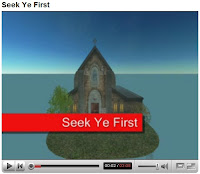 It uses images from Second Life in a Christian music video. I watched, curious about how denominations are being represented ... (Can you tell which is presented by the images offered?) Initially, I was impressed by the Cathedral's re-creation, then I reacted to what seemed like a marketplace for religious articifacts embedded at the end.... Wondering what significance those images held, I followed the link at the end http://www.peacebella.com/.
 It uses images from Second Life in a Christian music video. I watched, curious about how denominations are being represented ... (Can you tell which is presented by the images offered?) Initially, I was impressed by the Cathedral's re-creation, then I reacted to what seemed like a marketplace for religious articifacts embedded at the end.... Wondering what significance those images held, I followed the link at the end http://www.peacebella.com/.
I was struck by Peacebell'as description of her Second Life experience and her husband's activity online... there is an obvious tension in her writing about her husband's and society's emphasis on money... one of her sites is titled "money sick".... and the constrast she presents through her faith and beliefs throughout her sites, videos and writings... check the list of tags that make the words used most often the biggest.... as well as her site see http://www.peaceinspiration.com/faith/jesus-wisdomchristianity/
"Peacebella" is a pseudonym so we don't know who she is... http://www.peaceinspiration.com/about-me/
I keep wondering about the elements of her ecology that formed and fashioned her...
Fashioning-A-People Endebted to Media Ecology
 Building on the work of Marshall McLuhan, Neil Postman's first published definition was in his essay "What is Media Ecology," excerpted from “The Reformed English Curriculum,” High School 1980, ed. A. C. Eurich (NY: Pitman, 1970):
"Media ecology looks into the matter of how media of communication affect human perception, feeling, understanding, and value; and how our interaction with media facilitates or impedes our chances of survival. The word ecology implies the study of environments: their structure, content, and impact on people. An environment is, after all, a complex message system which imposes on human beings certain ways of thinking, feeling, and behaving. It structures what we can see and say and, therefore, do. It assigns roles to us and insists on our playing them. It specifies what we are permitted to do and what we are not. Media ecology tries to make these specifications explicit. It tries to find out what roles media force us to play, how media structure what we are seeing, why media make us feel and act as we do. Media ecology is the study of media as environments."
As Camille Paglia states in this clip from YouTube (http://www.youtube.com/watch?v=4KIRjvvAegw), Media Ecology is an analysis of the entire environment within which we operate... that change us, that become us! I believe this type of analysis is essential for those responsible for making Christians!
While reflecting on the environments that shaped me as a youth and young adult, I am mindful of the myriad of complementary messages that were a part of my life. Repeating themes of God's unconditional love and a call to respond in love to build God's reign consistently came from my parents and extended family, my parochial school and high school communities, the communal worship experiences within which I was fed and sent. Stories of our ancestors in faith caring for the least of these were reinforced by Lassie saving the day, Laura Ingalls overcoming obstacles with grace and charity, and calls for social jusice in the folks songs we sang around the campfire. I recognize that the world that I thought I was in was not always the same as the world I was in. Critical thinking helped me recognize the levels of reality that can exist simultaneously. Still, there was a security in hearing similar themes from every aspect of my world and trusting that God is present.
Today, the world feels more fragmented. As John Westerhoff suggests, there is a "broken ecology." Messages compete with rather than complement the Christian Message. It is harder to discern what is "true." The focus is on me, not we.
Hopefully, by using an ecological lens we can make that which is implicit, explicit. By doing so, I believe that we can reclaim some control over the environment within which we operate and claim our role as God's stewards of all creation. Only then can we infuse it with values that encourage the common good.
Time Warp

We'll, I've created my first blog and spent way too much time trying to get a banner image for "Fashioning-A-People" in my header. It's amazing how much time can simply disappear when working online.
Subscribe to:
Posts (Atom)
